NTC vs. RTD Temperature Sensor Manufacturing: Process & Automation Guide
While most guides compare NTC and RTD electrical curves, factory directors care about how element physics changes automation tooling, welding yield, encapsulation, and calibration speed.
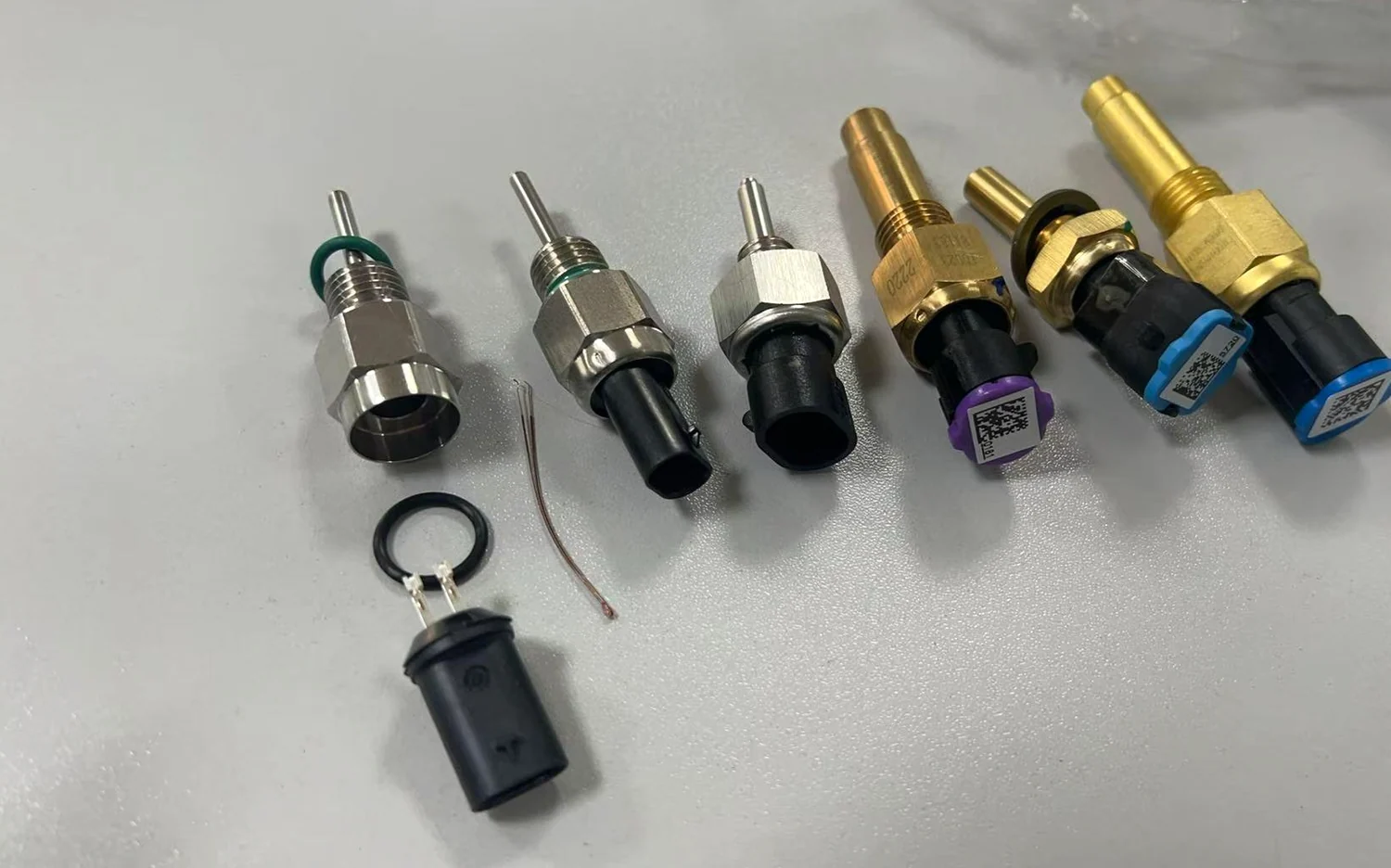
Key engineering takeaways
- NTC thermistors dominate high-volume HVAC, appliance, and EV BMS/coolant lines (18,000–30,000 PCS/day) where standardized 13 mm carrier boards deliver 10–16 month automation payback.
- Thin-film PT100/PT1000 RTD elements require lower mechanical clamping stress, zero-flux micro resistance welding, and quick-change nests suited to high-mix industrial and medical probes.
- Across both NTC and RTD lines, 80% of field failures originate in three steps: <0.1 mm lead joining, trapped epoxy air voids, and incomplete end-of-line dielectric/R-T verification.
How NTC Thermistor and RTD Physics Shape Production Line Design
Negative Temperature Coefficient (NTC) thermistors use sintered metal-oxide ceramic semiconductors whose resistance drops sharply—typically 3% to 5% per °C around 25°C—as temperature rises. That high sensitivity makes NTC probes inexpensive to read and ideal for EV battery thermal management (BMS), traction drive-motor windings, engine coolant loops, refrigerators, and heat pumps.
Resistance Temperature Detectors (RTDs), led by thin-film and wire-wound PT100 and PT1000 platinum elements, deliver near-linear resistance curves across -200°C to +600°C with minimal long-term drift. However, platinum elements cost more per chip, exhibit far smaller resistance shifts (~0.385 Ω/°C for PT100), and are typically produced in smaller, high-mix industrial, aerospace, and medical batches.
From a manufacturing automation standpoint, that difference dictates factory architecture: high-volume NTC plants scale cleanly on continuous multi-stage carrier-board lines (CR-494 → CR-287 → CR-726A → CR-419 → CR-726D), whereas RTD probe houses maximize ROI with compact quick-change modular cells.
Step-by-Step NTC & RTD Sensor Manufacturing Process
Regardless of whether your plant builds MF58 glass-sealed axial probes, MF52 epoxy beads, or stainless-steel PT1000 assemblies, reliable automated sensor manufacturing follows six tightly coupled process gates:
- 1. Wire Cutting, Stripping & Core Preparation: Multi-spool machines (such as CR-494H) cut PVC, silicone, or high-temp PTFE leads to ±0.5 mm length tolerance. For >150°C automotive NTC and RTD probes, mechanical/ultrasonic core squaring (CR-287Y2) prepares stranded wire for flux-free welding.
- 2. Precision Micro-Welding or Soldering: Fragile MF58 glass seals crack if forming torque hits the glass-to-metal shoulder. Dedicated magnetic-box feeders and closed-loop DC inverter resistance welders (CR-287D/F/H) hold consistent axial pull force without heat-soaking the ceramic or platinum chip.
- 3. Inline Optical & AI Defect Screening: Multi-angle CCD cameras (CR-726A) and ±20 μm telecentric optics catch flying-wire strands, cold joints, ceramic sleeve detachment, and hairline glass cracks before probes consume housings and epoxy.
- 4. Housing Assembly, Encapsulation & Curing: Vacuum-degassed volumetric epoxy potting (CR-419 / CR-4004) or high-speed silicone dip coating (10,000–14,000 PCS/H) eliminates thermal-insulating air pockets inside probe tips, followed by dual-zone tunnel oven curing (e.g., 80°C preheat + 150°C cure).
- 5. Mechanical Staking, Cleaning & Traceability: Automotive metal housings require force-displacement monitored 5T servo riveting and X/Y/Z laser DataMatrix marking so every probe carries a permanent serial ID.
- 6. End-of-Line Hi-Pot & R-T Calibration: Dual-bath thermal testers (CR-726D at 0°C/25°C/85°C) or oil-free reference air chambers (CR-726D3) verify insulation dielectric strength and resistance tolerance while writing 1:1 genealogy data to MES.
NTC vs. PTC vs. RTD: Selecting the Right Automation Investment
Engineers often ask how PTC (Positive Temperature Coefficient) thermistors fit alongside NTC and RTD lines. PTC elements increase resistance sharply above a Curie switching point and are primarily used for over-current protection or motor stall alarms rather than continuous linear temperature measurement. Mechanically, radial/axial PTC sensors share wire-prep, cleaning, and potting equipment with NTC lines, though test benches must support trip-temperature verification.
For plants transitioning from manual assembly, the smartest investment order is rarely automating every station on day one. Start by automating the highest-labor or highest-scrap bottleneck—usually wire alignment + thermistor welding, or end-of-line Hi-Pot & resistance sorting—on a standardized 13 mm carrier ecosystem so downstream modules drop in later without re-engineering fixtures.
| Manufacturing Dimension | NTC Thermistor Lines | RTD (PT100 / PT1000) Cells | PTC Protection Probes |
|---|---|---|---|
| Typical Sensitivity & Range | -3% to -5%/°C (-55°C to +200°C+) | ~0.385 Ω/°C linear (-200°C to +600°C) | Sharp step rise at Curie threshold |
| Typical Plant Volume | 18,000–30,000 PCS/day per line | 1,000–8,000 PCS/day (high-mix SKUs) | 5,000–20,000 PCS/day |
| Preferred Joining Process | Inverter resistance weld or tin/solder | Flux-free micro resistance weld / laser | Resistance welding / crimping |
| Critical Vision Gate | ±20 μm glass crack & flying-wire AOI | Lead alignment & thin-film chip check | Solder fillet & insulation sleeve |
| EOL Test Architecture | CR-726D (25°C/85°C) or CR-726D3 air | Precision 4-wire Kelvin R-T + Hi-Pot | Ambient R25 + trip-point Hi-Pot |
| Recommended Line Strategy | Standardized 6-stage turnkey line | Quick-change modular standalone cells | Modular weld + potting + sort cells |
Engineering Q&A
Which temperature sensor is more accurate: NTC thermistor or RTD?
Are NTC thermistors polarized during automated feeding and welding?
Can one automated assembly line handle both NTC and RTD sensor probes?
More engineering guides
All 7 guidesHow to Test NTC Thermistors & Run Production Hi-Pot Tests Without Bottlenecks
Air-Based vs. Fluid-Bath Resistance Testing in NTC Sensor Manufacturing
Designing IATF 16949 Traceability into Automotive Temperature Sensor Lines