Vacuum Potting Process: Eliminating Voids in Automotive NTC Sensor Epoxy
Microscopic air bubbles inside a potted probe tip destroy thermal response time (T63/T90) and cause Hi-Pot failures under thermal shock. Here is how automated vacuum potting stops voids at the source.
Key engineering takeaways
- Pair vacuum resin degassing with bottom-up retractable dispensing needles so epoxy displaces air cleanly upward out of deep metal probe tips.
- Monitor adhesive mass inline before and after dispensing to catch resin viscosity drift before probes enter the curing tunnel.
- Use two-stage thermal curing profiles (80°C low-viscosity preheat followed by 150°C cure) so trapped micro-bubbles escape before gelation locks them in.
Why Trapped Epoxy Voids Destroy Sensor Response & Dielectric Strength
In EV drive-motor, battery BMS, and engine coolant temperature sensors, thermally conductive epoxy or silicone forms the sole heat-transfer bridge between the brass/stainless shell and the NTC bead. Air is a severe thermal insulator: even a 0.5 mm pocket near the probe tip slows T63/T90 thermal response time and creates localized electric-field concentration points that break down during 500V–3,000V Hi-Pot tests.
Manual syringe potting fails automotive Cpk requirements because resin viscosity climbs continuously across its pot life while operator trigger pressure, insertion depth, and withdrawal speed vary every cycle.
Four Controls Built into Automated Sensor Vacuum Potting & Coating Lines
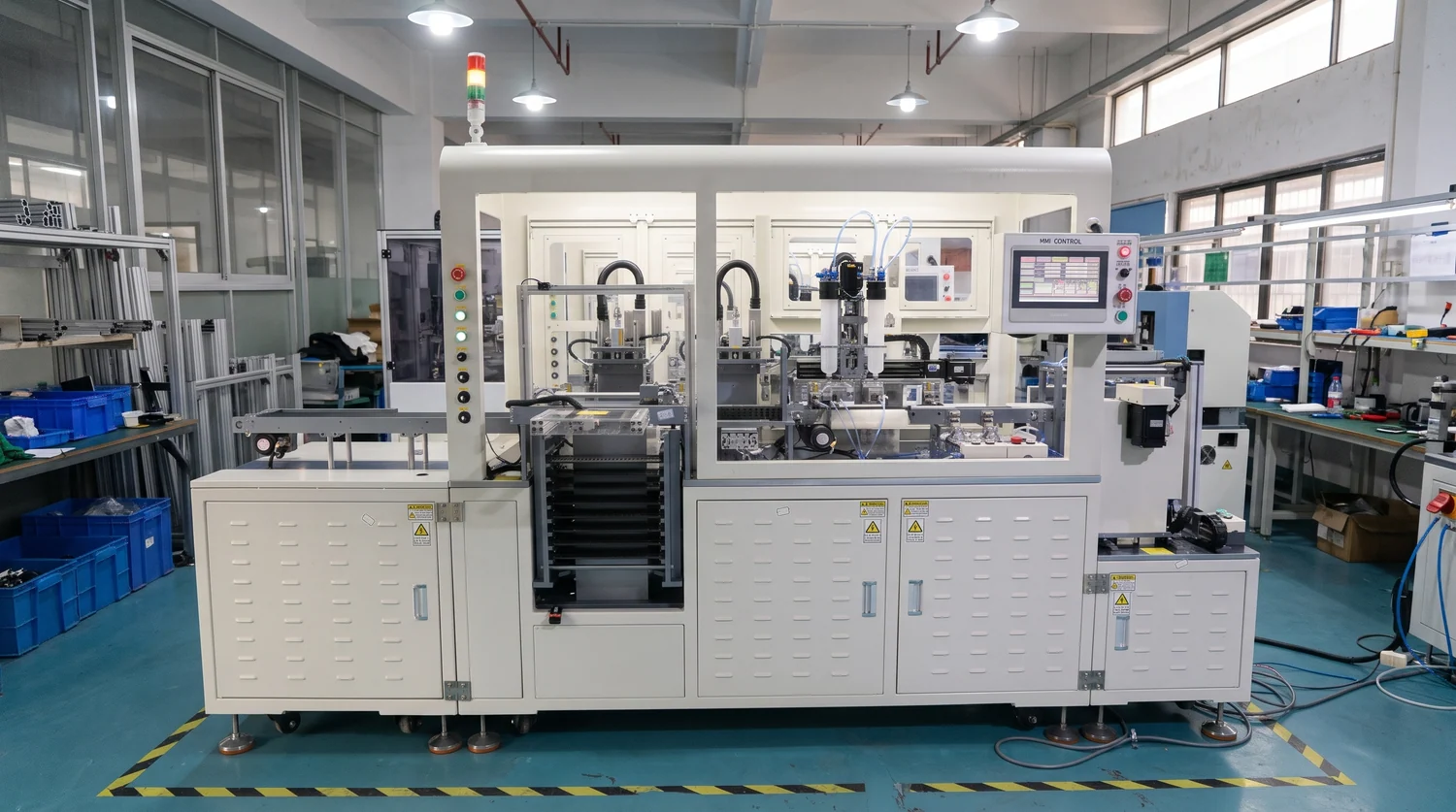
Across our CR-419 high-speed housing potting machines (4,000–6,000 PCS/H), CR-4004 precision 3-axis dispensers, and 10,000–14,000 PCS/H silicone dip coaters, four coordinated controls keep void rates near zero:
- 1. Vacuum Mixing & Degassing Feeders: Removes dissolved micro-air from two-part thermally filled epoxies before resin enters pressurized metering valves, preventing air entrainment during high-speed pumping.
- 2. Bottom-Up Needle Retraction & Optical Alignment: Long stainless needles travel to the bottom of the sensor cavity and dispense while retracting smoothly upward—paired with automated optical needle alignment after syringe swaps and programmable lint-free nozzle wiping.
- 3. Inline Pre/Post-Dispense Precision Weighing: On automotive coolant and EV motor lines, every probe shell crosses a precision balance before and after potting; under-filled or over-filled housings halt and flag NG immediately.
- 4. Multi-Zone Controlled Curing (CR-9368A Tunnel Ovens): Gradual preheating (such as 80°C for 10 minutes) temporarily lowers resin viscosity so micro-bubbles rise and vent before cross-linking locks the cure at 150°C.
Atmospheric High-Freq Vibration vs. Full Vacuum Chamber Potting
Not every sensor housing requires a full vacuum potting chamber, which adds evacuation cycle time. Open-mouth HVAC bullet probes with moderate-viscosity epoxy achieve excellent zero-void results using pre-degassed resin, bottom-up needles, and high-frequency post-dispense vibration (CR-419). Deep narrow stainless automotive thermowells (>40 mm depth, <4 mm ID) filled with high-viscosity alumina-loaded thermal compounds benefit most from dedicated vacuum degassing plus vacuum-assisted potting.
| Observed Defect | Primary Root Cause | Automated Equipment Control |
|---|---|---|
| Tip void / slow T63 thermal lag | Top-down pouring traps air at closed tip | Bottom-up servo needle retraction + vacuum degassing |
| Hi-Pot arc through epoxy wall | Micro-bubbles expand during rapid hot cure | Dual-zone curing (80°C preheat → 150°C cure) |
| Inconsistent bead-to-shell fill weight | Pot-life viscosity thickening over shift | Inline pre/post weighing + heated metering manifold |
| Resin strings on external threads | Drip/tailing on needle pull-out | Vacuum suck-back valve + auto lint-free tip wiper |
Engineering Q&A
How do you verify zero internal voids without destroying every automotive sensor?
What throughput can automated epoxy potting machines achieve on NTC probes?
More engineering guides
All 7 guidesAI Visual Inspection & ±20 μm AOI for Glass & Welded NTC Sensors
NTC vs. RTD Temperature Sensor Manufacturing: Process & Automation Guide
How to Test NTC Thermistors & Run Production Hi-Pot Tests Without Bottlenecks